

Taste vs Strategy: Why Being a Good Designer Isn’t Enough
If your brand redesign hinges on whether the boss “just likes the color blue,” beware. In business, design isn’t about personal style – it’s about results. As an Art Director at Hubert+Partners I’ve seen countless projects stall or stumble because stakeholders chased good taste instead of a clear strategy. It’s like painting by whim and hoping for profit. Today’s fast-paced market rewards companies that blend creativity with a plan, not those indulging subjective whims.
“Taste” and “Strategy” in Design
In practice, taste means personal or trendy aesthetic choices – “I like this layout” or “Minimalism is hot right now.” It’s driven by individual preference or what looks pretty. Strategy, by contrast, is the roadmap behind design. It starts with research: customer insights, brand positioning, and clear business goals. Strategy asks, “Who needs this design and why? What problem are we solving?” rather than “Is it visually appealing?” In short, taste is style; strategy is purpose.
The Pitfalls of Pure Aesthetic Design
Relying on taste alone invites risk. By definition, individual preferences are subjective and often arbitrary. UX experts warn that user testing must screen out “random, purely subjective preferences (such as ‘I like purple’)” because such whims rarely match what customers care about . In real projects this shows up as endless debates over fonts or colors with no grounding in user needs. The result? Inconsistent branding, wasted budget on redesigns, and confused customers.
Brand Confusion: Without strategy, different design ideas fight for attention. Each team member has their own “nice” idea, so the brand ends up looking different everywhere. That dilutes recognition and trust. (Studies show consistent branding across channels can boost revenue by ~23% – which taste-driven “hodgepodge” approaches undermine.)
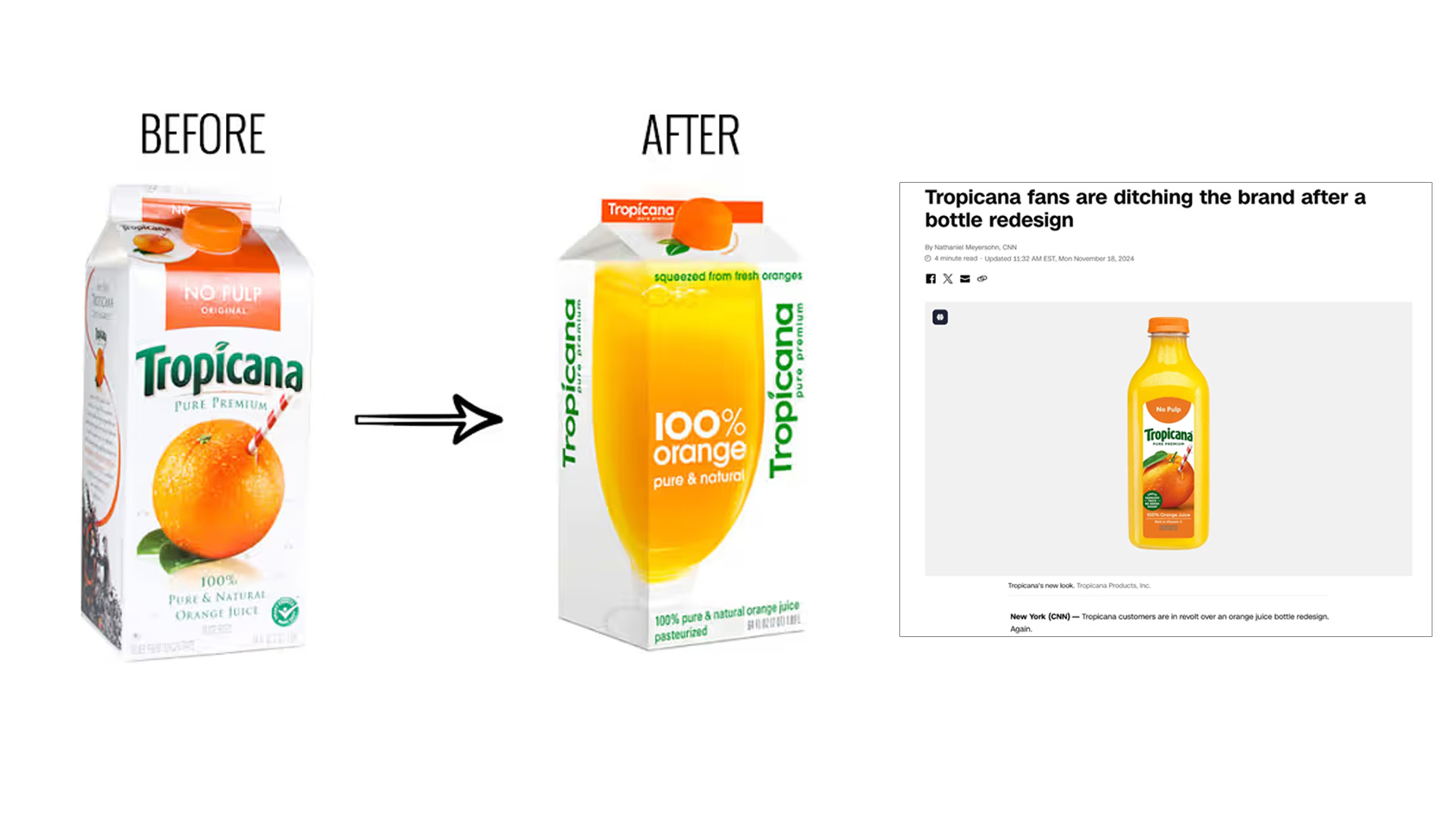
Missed Customers: A sleek design may win an internal thumbs-up but lose customers. For example, Tropicana’s 2009 “modern” juice carton (above) dropped the iconic orange image in favor of a generic glass of juice. Loyal buyers recoiled – sales plunged 20% (≈$30 million loss) within two months . The culprit? A pretty new look that ignored what buyers loved about the original package. (“We thought it would be important to… evolve [the brand] into a more current state,” the agency said – and learned the hard way that fresh doesn’t always mean effective.)
Time and Ego Waste: Design by taste drags on. Every well-intentioned tweak or “best practice” argument becomes a personal battle. Teams get caught in “your taste vs. my taste” mudslinging. This delays projects and frustrates the people who pay the bills – the business leaders. In our agency we joke: “Design by committee usually ends up as design by no one.
Why Strategy-Led Design Works
Strategy brings design back to earth. It forces designers and clients to answer business questions like “Who are we talking to?” and “What do they need?” before even choosing colors. This user-centric, data-informed approach yields measurable gains. In fact, McKinsey found that companies that integrate design thinking into their strategy outperformed peers by a wide margin. In one study, top-quartile design-oriented firms grew revenue 32% faster and delivered 56% higher shareholder returns over five years . Another analysis showed that customer-centric companies (those channeling user insights into strategy) beat competitors by 10% during the 2008–09 recession – and that advantage tripled after three years . The lesson? When design serves business goals, the bottom line follows.
Research-Driven Creativity: Good strategy starts with research. Instead of “Do you like it?”, an agency asks “Will our core customers respond to it?” A chef analogizes this as mise en place – prep work before cooking. As one branding expert puts it, “research is the essential first step in impactful branding” . By gathering insights (markets, competitors, target lifestyles, etc.), you build a solid recipe for creative work. If research favors bold orange branding but the client hates orange, that’s a clue: either reframe to align with customer data or risk failure.
Consistency and Focus: Strategy keeps the brand coherent. Every design decision is a calculated ingredient in a recipe, not a random garnish. For example, Alina Wheeler’s Designing Brand Identity (shown below) emphasizes aligning logo, packaging, messaging – all elements – to a unified brand story. This kind of consistency makes a brand memorable. (Indeed, marketing research shows consistent brand presentation greatly improves visibility and trust .)
Quick Learning: Strategy embeds testing and iteration. Instead of wondering “will they like this?”, you actually test concepts (online surveys, focus groups, A/B tests). This eliminates bias and spot-checks taste. Nielsen Norman Group notes that testing can “screen out random, purely subjective preferences” , so decisions aren’t held hostage to the loudest opinion in the room.
Wake-Up Call for Leaders: Business Needs Strategy, Not Vanity
From our vantage point across Europe and Vietnam, we see it often: executives caught in discussions about “taste” rather than traction. They ask, “Do you feel this logo?”, ignoring that design’s job is to move the business – capture attention, tell a story, solve a customer problem. Great design does both, but when push comes to shove, business wins.
Consider retail shelf packaging. A brand can only afford one shot to stand out. A design chosen for its “beauty” might blend in; one chosen for its strategic contrast or signal will leap out of the freezer aisle. Or think of product launches: marketers need a brand look that hits the right notes with investors and customers alike – not just something the art director “likes.” Real ROI comes when your identity resonates with the market.
Visualize it: One powerful illustration is a side-by-side “before vs. after” brand mockup (like the Tropicana example above) showing a taste-based design vs. a strategy-informed one. Another helpful graphic is a decision-flow diagram, where one path (“Based on CEO’s taste”) goes off track and another (“Based on user research”) leads to success. You might also quote a blunt client insight: “I hated the first concepts, but sales love them,” to emphasize that function trumps form. These visuals drive home the point that strategy beats decoration in the long run.
Key Takeaways
Aesthetic alone won’t save a brand. Pretty visuals can get likes, but strategy-driven design gets loyalty, leads, and revenue.
Data and purpose over ego. Always start with questions about customer needs, brand promise, and business objectives – not “Do I like it?”
Invest in design strategy. As multiple reports show, companies that weave design into planning enjoy better outcomes . In our experience, design without strategy is decoration at best, disaster at worst.
Business leaders – push back on vague “I just don’t like it” feedback. Demand strategy. A design that pleases a boardroom but fails the market is a flop. Instead, prioritize a clear plan: research first, then creativity. As one agency insider quips, “The best logo isn’t the prettiest one – it’s the one that makes people stop, remember, and trust.” The question isn’t “Do you like this design?”; it’s “Will it hit our goals?” Focus there, and watch your brand deliver real results.